SUMMARY |
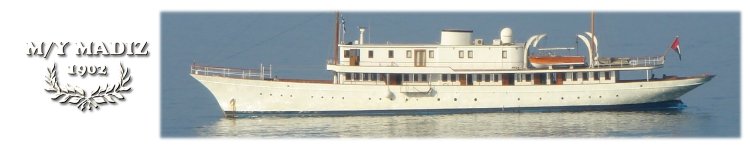
- MADIZ, a large meter steel yacht built in 1902 at Ailsa Shipyards, on the river
Clyde, at Troon, Scotland. She is the oldest steel or iron vessel to be classed by Lloyds Register.
- During 2004-2007 Madiz underwent a major refit and was
re-classed under Lloyds Register to her original Class of +100A1, making her the only ship
to ever do so.
- Additional works during 2010-2012 have brought Madiz to a very high standard of
luxury and mechanical excellence, without in any way affecting her unique antique quality.
- Madiz was designed by G. L. Watson, the pioneering
yacht designer, who created the first design office exclusively for yachts and who
designed some of the most successful Americas Cup yachts. It is the last surviving ship to
have been designed by him personally.
- In the 2nd World War, she served in the Royal Navy as a Royal Patrol Yacht, carrying King George VI, Queen Elisabeth and
the then Princess Elisabeth down the river Foyle on a victory tour of Londonderry.
- During this period MADIZ also participated in the
development of the Radar, by carrying out the trials for the calibration and development
of HF/DF (High Frequency Direction Finder,
a prelude to the radar).
It is interesting to note that, as available records show, MADIZ and the Norwegian Royal Yacht Norge, built in
1929, are probably the only ships still active that were involved in the Battle of the Atlantic.
- At the request of Granada Television, Madiz was once used for the filming on her
of Agatha Christies Poiroit episode
“Problem at Sea”. No other such requests were ever granted.
|
|